
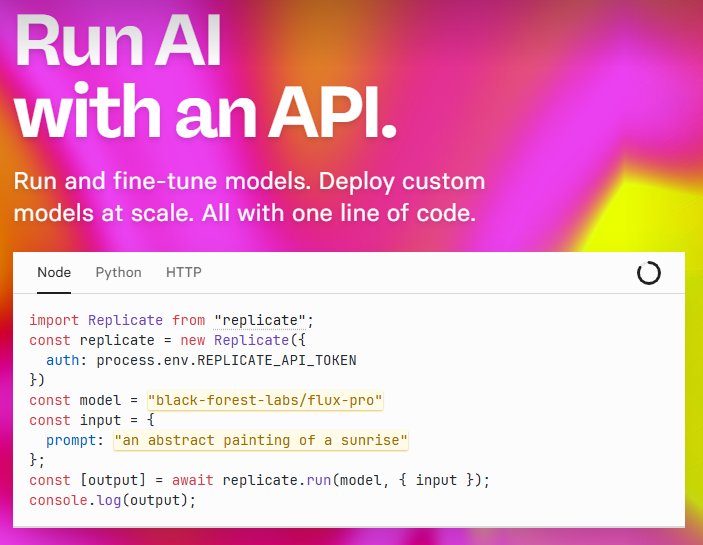

Replicate.com is a cloud-based platform designed to democratize access to artificial intelligence by making it easier for developers to run machine learning models without needing extensive ML expertise or dedicated infrastructure. The platform serves as a bridge between complex AI technologies and practical implementation, allowing developers to harness the power of various AI models through simple API integrations.
Core Platform Overview
Replicate positions itself as “the foundation for open-source AI,” providing a comprehensive ecosystem where developers can access and deploy a wide range of machine learning models. The platform eliminates many of the traditional barriers to AI implementation by handling the complex infrastructure requirements that typically accompany machine learning deployments. Users can run AI models with just a cloud API, without having to understand the underlying machine learning principles or manage their own hardware resources.
The platform’s design philosophy centers on accessibility and flexibility. Developers can choose from thousands of open-source models that others have published, bring their own training data to create fine-tuned models, or build and publish entirely custom models from scratch. This approach makes advanced AI capabilities accessible to a much broader audience of developers who may lack specialized machine learning knowledge.
Deployment and Integration Model
Replicate’s infrastructure is built to handle the challenging aspects of AI deployment, such as GPU provisioning and scaling, allowing developers to focus on application logic rather than infrastructure management. The platform can automatically generate scalable API servers for custom models, significantly reducing the development overhead typically associated with deploying machine learning models.
From a technical perspective, Replicate enables users to run models with minimal code requirements. Many of the platform’s generative AI models can be accessed and utilized with just a few lines of Python code, making integration into existing applications relatively straightforward. This low-code approach aligns with the platform’s goal of making machine learning more approachable for developers of varying expertise levels.
Key Features and Capabilities
Extensive Model Library
Replicate’s offering includes an extensive library of pre-trained, generative AI models spanning various domains and applications. These models cover a wide range of tasks, including image generation, natural language processing, video generation, music creation, and speech synthesis. Popular AI models available on the platform include Stability-ai’s Stable Diffusion for image generation, Meta’s Llama language models, and Tencent’s GFPGAN for image processing.
Flexible Deployment Options
The platform supports multiple approaches to model deployment. Users can:
- Run existing open-source models directly from the platform.
- Deploy their own public or private models.
- Create fine-tuned versions of existing models using custom training data.
This flexibility allows developers to either leverage pre-built solutions or create customized implementations based on specific requirements.
Webhooks and Real-time Updates
Replicate provides webhook functionality that delivers real-time updates about predictions, allowing developers to build responsive applications that can react to model outputs as they become available. This feature is particularly valuable for applications requiring timely processing of AI-generated content.
Organization Management
For team environments, Replicate offers organization features that facilitate collaboration by allowing shared access to models, API tokens, billing information, and dashboards. This makes the platform suitable not just for individual developers but also for teams working collectively on AI implementation projects.
Business Model and Growth
Replicate operates on a pay-as-you-go pricing model, where users are billed only for the compute time used to run their models. This consumption-based pricing structure makes the platform accessible to developers and organizations of varying sizes, from individual practitioners to enterprise clients.
Notable Growth and Adoption
Replicate raised $40 million in Series B financing in December 2023, led by Andreessen Horowitz with participation from Nvidia’s venture capital arm NVentures, Heavybit, Sequoia, and Y Combinator. This funding underscores investor confidence in Replicate’s approach to AI accessibility.
As of December 2023, Replicate reported:
- Two million software developers registered on the platform.
- 30,000 paying customers, including companies like Buzzfeed, Getty-owned Unsplash, Character AI, and Labelbox.
These organizations use Replicate to run open-source models for applications ranging from content generation to specialized AI services.
Application Areas and Use Cases
Replicate’s platform supports a diverse range of applications across multiple domains. Developers have used the platform to build:
- Autonomous robots.
- Real-time drawing applications.
- Language model command-line interfaces.
- Image generation systems.
- Text processing applications.
- Video creation tools.
- Music and speech synthesis solutions.
The platform’s flexibility suits both experimental projects and production applications, with users scaling implementations as needed. For enterprise clients, Replicate is expanding its offerings to include services focused on security, compliance, and model performance monitoring.
Conclusion
Replicate.com represents a significant step toward making machine learning more accessible to the broader developer community. By abstracting away much of the complexity associated with AI deployment, the platform enables developers to focus on creating innovative applications rather than managing infrastructure. As AI continues to evolve and permeate various industries, platforms like Replicate play a crucial role in democratizing access to these technologies, allowing more developers to incorporate advanced AI capabilities into their software solutions.
With its ease of use, flexible deployment options, and extensive model library, Replicate has positioned itself as a valuable resource for developers seeking to leverage AI without specialized expertise in machine learning or dedicated hardware resources.
 Facebook
 LinkedIn
 X
X
 Reddit