
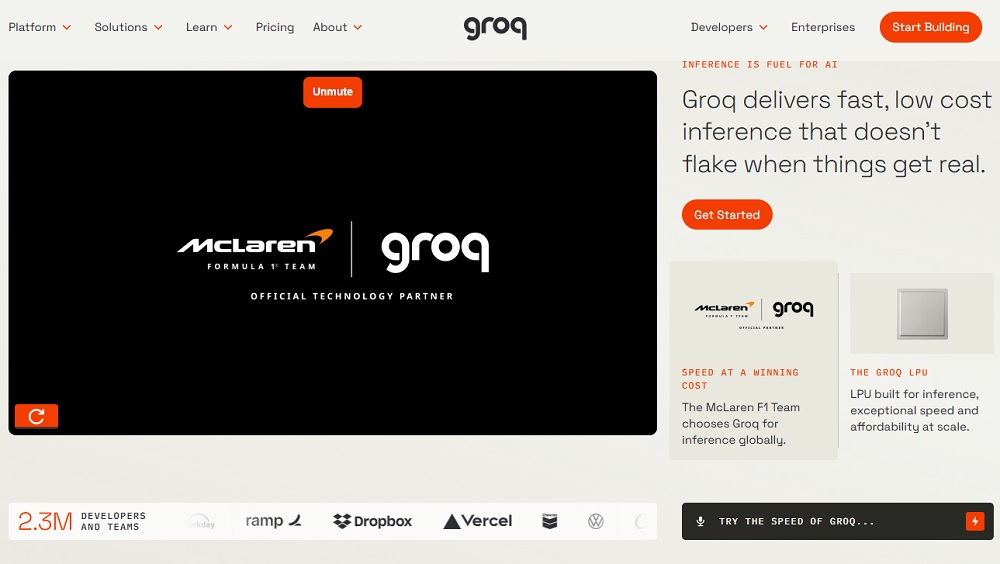

What is Groq AI?
Groq is a company founded in 2016 by former Google engineers. It builds both hardware and software to accelerate inference—i.e. when a trained AI model is put to work, as opposed to training the model from scratch. Groq’s core product is its custom chip called the Language Processing Unit (LPU), and an associated infrastructure (GroqCloud) that allows developers and enterprises to run large language models (LLMs) and other AI workloads more quickly and efficiently.
Key Features & Technical Strengths
- Low Latency, High Throughput
Groq has been shown in independent benchmarks to deliver very high token throughput and very fast “time to first token” latency. For example, with Llama 2 70B, in a benchmark by ArtificialAnalysis.ai, Groq achieved ~241 tokens/second, which is more than double what many competitors do.The benchmarks are “live” (updated regularly) and reflect more realistic usage patterns (prompts of ~100 tokens, responses of ~200). - Specialized Hardware (LPU)
Their chip is designed for inference rather than training. It emphasizes sequential processing and optimized design rather than general-purpose compute. This means tasks like generating text, answering queries, chatbots, etc., can be very fast. - Support for Open-Source Models
Groq currently supports several open-source large language models like Llama 2 70B. This appeals to users who want more transparency or to avoid paying for proprietary LLM access. - Scalability & Deployment Flexibility
They offer both cloud-based inference (GroqCloud) and the possibility of on-premises or large-scale deployment via linked hardware units (“racks of GroqCards,” etc.) for organizations needing more control. - Energy Efficiency & Cost Potential
Because the LPU is specialized for inference, there are claims that it uses less power (better efficiency) vs general-purpose GPUs under many inference workloads. This helps when scaling or when low latency is critical.
Weaknesses & Limitations
No system is perfect. Here are the trade-offs and challenges that users of Groq have noted:
- Inference-only vs Training
Groq doesn’t train large models—it focuses on inference. If your project needs to both train new models and deploy, you may still need more general-purpose GPUs or hybrid solutions. - Ecosystem & Maturity
While Groq has promising performance, its ecosystem is newer compared to NVIDIA, AMD, or more established GPU vendors. This means fewer community tools, possibly less documentation or third-party support, and fewer “battle tested” workflows. - Model Limitations
- Limited selection: mainly open-source LLMs; if your use-case needs proprietary or very specialized models, they might not be supported.
- Sometimes, users report fluctuations in latency (e.g. fast in some cases, slower or variable in others) especially if many requests, or under specific prompt types.
- User Experience / Interface
Some critics mention that while speed is excellent, the GUI / console interfaces are less polished or feature-rich compared to tools like ChatGPT, Claude, etc. Saving history, managing conversations, ease of use etc. may not be as advanced. - Cost & Scaling Concerns
For small or experimental use, it looks promising. But as usage scales, cost per token, API costs, or infrastructure demands may become significant. Also, for organizations concerned with data governance or privacy, cloud vs on-prem trade-offs matter.
Real-World Usage & Feedback
Some user and community observations:
- Many users are impressed by how fast Groq responds—even “near-instantaneously” in some settings.
- For simple tasks (text generation, cleaning transcripts, etc.) Groq performs very well; for more complex reasoning, some users feel its strengths are less pronounced.
- Some complaints about latency variation: while best case is great, sometimes the worst case (or average under load) isn’t as stable.
Competitive Landscape
Groq isn’t alone. It’s in a race with:
- NVIDIA / GPUs — very mature ecosystem, good support for both training & inference, huge user base. But GPUs often are less efficient specifically for inference tasks.
- Other AI chip startups / accelerators — companies trying to speed up inference, reduce energy usage, etc.
- Cloud API providers — OpenAI, Google, Anthropic, etc., which may have overheads but a wide range of models, polished interfaces, etc.
To compete, Groq must keep pushing down latency, increase model support, ensure reliability under diverse workloads, and manage cost.
Business & Financials
- Groq has secured major funding: e.g. $1.5B commitment from Saudi Arabia.
- Its valuation has been rising; reports cite valuations in the billions.
- However, there have been projections revised: some public sources say earlier revenue estimates were optimistic, and Groq has had to adjust. That suggests high growth potential but also risk.
Who Is Groq Best For?
Groq is especially compelling if you are:
- Building applications where inference speed & low latency are mission-critical (chatbots, real-time interaction, voice assistants, etc.).
- Using or wanting to use open source LLMs.
- Running workloads where cost per query / latency trade-offs favor specialized hardware over general purpose GPUs.
- In sectors where energy efficiency or hardware footprint matters.
It might be less ideal if you need to:
- Train large models yourself.
- Depend on a broad variety of proprietary or uncommon models not yet supported.
- Have very strict requirements about stability / worst-case latency, or need super polished user interfaces out of the box.
- Wish for widespread documentation, tooling, support that comes with established providers.
Future Prospects & What to Watch
What will likely matter going forward:
- More model support (both in variety and in domain-specific LLMs).
- Improved UX and tooling, especially front ends, history, etc.
- Scaling & reliability under heavy load.
- Cost competitiveness vs cloud GPU offerings.
- Regulatory and data privacy features, especially for industries like healthcare, finance, where data sovereignty matters.
- Energy efficiency gains will become more important as AI usage (and inference workloads) scale globally.
Verdict
Groq represents a strong, promising entrant in the AI inference hardware / platform space. It delivers on its promise of speed, particularly for inference of large language models, and has made impressive benchmark claims that seem substantiated in many user reports. For many use-cases, especially those needing very fast responses, it could provide a major advantage.
However, it is not a silver bullet. There are trade-offs: less model diversity so far, less maturity in some tooling and ecosystem support, possibly cost or latency variation under load. Whether Groq is right depends heavily on your specific needs:
- If latency and throughput are your top priority, Groq is extremely competitive.
- If you need full stack flexibility (training + inference, many model types, etc.), or enterprise-grade stability / tooling right now, you might still consider more established providers or hybrid approaches.
 Facebook
 LinkedIn
 X
X
 Reddit