

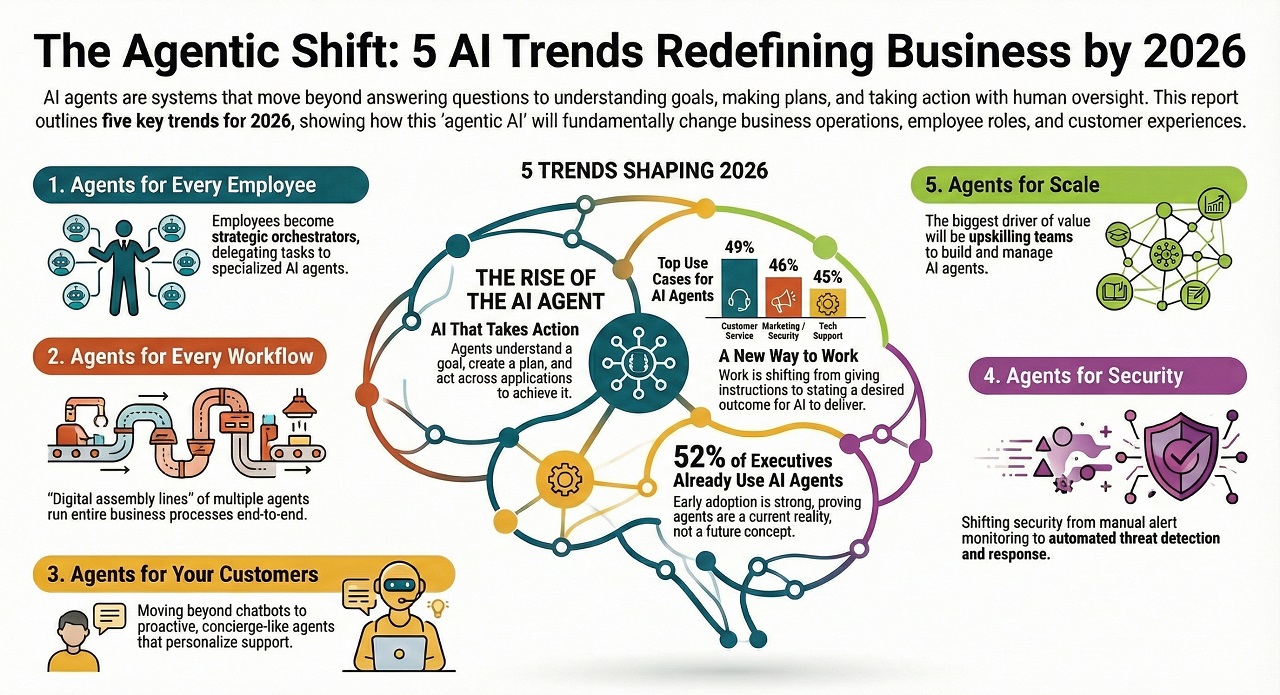
The constant stream of news about Artificial Intelligence can often feel abstract, focusing on a distant future. But while headlines chase possibilities, a more profound shift is already here: the rise of agentic AI. This is not just another tech wave like cloud or mobile; it represents a fundamental re-architecture of the enterprise. We are moving toward a new operating model for business itself, where AI moves beyond simply answering questions to understanding a goal, making a plan, and taking action across different applications—all with human oversight.
The key to making this new model reliable is a concept called “grounding”—anchoring an AI agent’s responses to a specific, verifiable set of facts, namely your own company’s internal data. This article distills the four most impactful and counter-intuitive takeaways for business leaders from the five key trends identified in Google’s “AI Agent Trends 2026” report. We’ll move past the hype to explore how these grounded systems will tangibly redefine our roles, workflows, and competitive landscape.
1. Your job isn’t being replaced—it’s being upgraded to ‘manager of AIs’.
The long-predicted paradigm shift from instructing computers to collaborating with them is finally here. We are moving from instruction-based commands, where we tell a machine how to perform a task, toward intent-based computing, where we simply state the outcome we want. In this new model, an employee’s role transforms from being a “doer” of every task into a “human supervisor of agents.”
Consider the “10x marketing manager” example from the report. Instead of manually drafting posts and pulling data, their role is to orchestrate a system of specialized agents grounded in the company’s own context:
- Data agent: Sifts through millions of data points to find actionable market patterns.
- Analyst agent: Monitors competitors, market trends, and social media sentiment 24/7.
- Content agent: Drafts social media and blog copy based on a strategic theme.
- Creative agent: Generates images and videos to accompany the content.
- Reporting agent: Connects to analytics platforms to pull and summarize campaign data.
The human’s role elevates to a paradigm shift in value creation, focusing on setting strategy, defining goals, and acting as the final checkpoint for quality and accuracy.
“There is a common misconception that agents act without control. Humans will remain the orchestrators and final decision-makers. Agents will function as powerful assistants to augment human-centric workflows.” — Albert Lai
But the real power is unlocked when these specialized agents are connected to run entire business processes, turning individual augmentation into enterprise-wide transformation.
2. Customer service is flipping from reactive to proactive.
For the past decade, automated customer service meant frustrating, pre-programmed chatbots. The next evolution is the “agentic concierge”—a helpful AI that remembers preferences and past conversations to solve problems, often before the customer even knows they exist.
The difference is night and day because the agent is grounded in your enterprise’s CRM, logistics, and purchase history data. Compare the old experience with the new:
- Chatbot: “Please enter your 12-digit order number.”
- Agentic concierge: “Hi, Elizaveta. I see you’re calling about the blue sweater you bought last week. Our system shows it was just delivered. Are you calling to start a return or an exchange?”
This proactive capability is even more powerful when things go wrong. Instead of waiting for an angry call about a delivery, a grounded agentic system takes the initiative:
- A logistics agent flags a failed delivery.
- The concierge agent checks the system and confirms a vehicle breakdown.
- It automatically reschedules the delivery for the next morning.
- It logs into the billing system to apply a service credit.
- It notifies the customer via text with a full summary:
This shift doesn’t just resolve issues efficiently; it builds customer trust by solving problems before they can escalate into frustration.
3. AI is moving from an ‘add-on’ tool to the core operating system of a business.
The next leap in value comes from connecting individual agents into a cohesive, grounded agentic system. This is the logical culmination of the “Chief AI Orchestrator” role—managing what can be thought of as a “digital assembly line.” This is the new operational fabric of the enterprise: a human-guided, multi-step workflow that orchestrates multiple agents to run a business process from end to end. This isn’t a distant dream; 88% of early adopters are already reporting a positive ROI from this approach.
“AI agents are the leap from being an ‘add-on’ approach to being an ‘AI-first’ process. It’s a fundamental change in workflow, a new way to work that will require a profound shift in mindset and corporate culture.” — Oliver Parker
These digital assembly lines will even operate between different companies. Using open protocols like Agent2Agent (A2A), agents from separate organizations can communicate and collaborate. For example, a media company’s agent could connect in real-time with a retailer’s agent to provide pricing and product details for an item shown in a video stream, creating a seamless experience.
4. The greatest challenge isn’t buying AI, but building an AI-ready workforce.
This is perhaps the most critical and overlooked takeaway. The most advanced technology is useless without people skilled enough to leverage it. As AI evolves, the skills gap is widening, with the “half-life” of a professional skill now just four years—and as short as two years in the tech sector. This gap is not just a challenge; it will be the primary determinant of market leadership in the agentic era.
“In 2026, the shift of employee scope to include agent management and orchestration will create a skills gap. It’s because the expertise to be an ‘agent orchestrator’ or ‘Chief of Staff for AI’ simply doesn’t exist in the market yet.” — Shweta Maniar
Success requires organizations to move beyond simply buying technology and adopt a new, human-centric strategy. The primary focus must be on building an AI-ready workforce through continuous learning, upskilling, and cultural change.
Conclusion: The Future of Work is More Human, Not Less
The agentic AI era is not about replacing people but about augmenting them. The true opportunity for competitive differentiation lies in freeing your teams from repetitive work to focus on the strategic, creative, and empathetic contributions that only humans can provide. The transformation is not in the tools we use, but in how strategy is conceived and executed when the “doing” is automated. This is how you will build a faster, smarter, and more human company that can out-innovate competitors.
As AI agents begin to manage our tasks, how will we learn to manage our agents?
Download: Google’s “AI Agent Trends 2026” report PDF
 Facebook
 LinkedIn
 X
X
 Reddit