
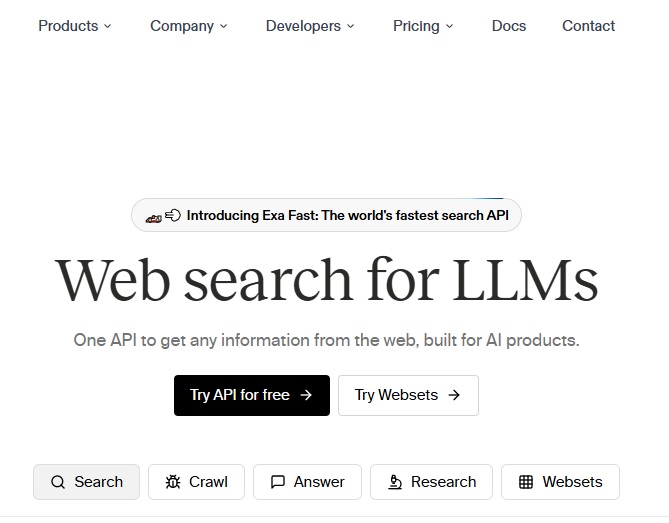

Exa AI is a cutting-edge, AI-powered search engine and web crawling platform designed specifically to enhance artificial intelligence applications by providing real-time, accurate, and contextually relevant web data. Unlike traditional keyword-based search engines, Exa utilizes Large Language Models (LLMs) and neural search techniques to understand natural language queries, user intent, and semantic meaning. This allows it to deliver highly relevant and verified information, significantly reducing issues like AI “hallucination” in AI models. Exa offers various products, including its core Web Search API, Exa Fast (the world’s fastest search API), and Websets for targeted data enrichment. It aims to give users “full control over the web’s data” and is a powerful tool for developers and businesses across numerous industries.
Key Themes and Innovations
1. Semantic Understanding and Intent-Based Search
- Beyond Keywords: Exa AI moves “beyond traditional keyword-based searching” by leveraging “vector search,” which enables it to “understand what you mean, not just the words you type.” This allows for a more intuitive and efficient search experience.
- Natural Language Processing: Exa understands and processes “natural language queries,” converting everyday human language into machine language to produce highly relevant results.
- Neural Search Technology: It employs “machine learning-based neural search technology for query processing,” combining it with traditional keyword methods to automatically choose the best search approach based on the query. This means it can discern the “semantic meaning of queries.”
2. Real-time, Verified, and High-Quality Data
- Continuous Web Crawling & Real-Time Indexing: Exa performs “continual web crawling, building an index from encoded pages,” and its “AI models refresh its data in real-time.” It crawls new URLs “every minute” to ensure the most current information.
- AI Verification of Results: A standout feature is its “AI helpers that check each result.” This verification process ensures that “the information is real and useful, not just something trying to get you to click.” For example, for “Modelle Shoes,” Exa “showed me that Websets had checked their website and found text saying they market ‘affordable’ shoes. It confirmed they operate in Turkey and focus on shoes as their main product.” This builds trust in the results.
- Curated Datasets and Filtering: Users can prioritize customization by focusing searches on “web subsets via date, category, and domain filters” and can access “curated datasets essential for training robust and reliable AI models.”
- Reducing AI Hallucination: By supplying “pertinent, accurate web content” to LLMs, Exa significantly “decreases hallucination, i.e., when AI ‘makes things up.'” This grounds AI responses in factual web content.
3. Comprehensive Features and Developer-Centric Design
- API Integration: Exa AI offers a “robust API that enables seamless integration of the technology with existing systems,” ensuring “fast, reliable, and scalable artificial intelligence search functionality.”
- Variety of Endpoints: The API includes /search for relevant URLs and content, /contents for crawling webpage contents, /answer for “Fast, web-grounded answers,” and /research for “Long-running research, for reports and structured outputs.”
- Websets Product: This tool helps users “Find a perfect list of results and enrich your data” based on “hyper-specific criteria” for sales, recruiting, and market research, providing verified company details and contact information.
- Data Access Options: Users can retrieve content in various formats, including “links, full text, key highlights, or custom summaries.”
- Developer Support: Exa provides “comprehensive developer tutorials” to help users maximize the tool’s potential.
4. Performance and Competitive Advantage
- Speed: Exa offers “Exa Fast: The world’s fastest search API,” with latency “Down to 500ms.”
- Superior Search Quality: Exa consistently “perform[s] state of the art compared to other search APIs” on various benchmarks, particularly excelling in “challenging Olympiad dataset” queries that “require semantic understanding.”
- RAG Enhancement: Exa “achieves the highest performance” in RAG Grading, meaning its full search allows LLMs to “produce more factually grounded RAG outputs.”
- Outperforms Traditional Search: In a user’s experience searching for affordable shoe companies in Turkey, traditional search yielded “expensive designer shoes, random shoe blogs, and online stores that shipped from… everywhere except Turkey,” while Websets provided a “clear list of companies, their website links, and even little checkmarks saying ‘Yep, they sell shoes!’ and ‘Yep, they operate in Turkey!'” Another user found Exa returned “exactly what I was looking for” for an obscure GitHub repo, where Google and Perplexity failed.
5. Use Cases and Industry Applications
- Sales: Find companies using specific technologies or with particular marketing strategies (e.g., “companies in Chicago that use AI for marketing”).
- Recruiting: Source candidates with “hard-to-describe qualities” or specific work experience (e.g., “software engineers in London who know AI and have worked at startups”).
- Investors: Identify new companies in specific sectors receiving funding (e.g., “new AI companies in health that are getting money from investors”).
- General Research: Ideal for finding academic papers, expert blogs, or market reports.
- Customer Support Automation: Streamline interactions by providing relevant answers to customer queries, decreasing response time.
- Content Recommendations: E-commerce platforms can suggest products based on user behavior.
- Healthcare and MedTech: Provide medical professionals with the latest research and treatment options.
- Financial Industry: Improve customer service, analyze vast financial data, and enhance employee search capabilities.
- Logistics: Apply to demand forecasting, supply chain visibility, and route optimization.
- Invent Value Idea Generator (Fresh Consulting): Integrates Exa to provide contextually relevant suggestions for brainstorming and ideation.
Important Facts and Figures
- Launch/Publication Date: Reviewed by AI IXX on March 1, 2025, and by Fresh Consulting on March 7, 2025.
- Core Technology: Leverages Large Language Models (LLMs) and neural search technology, including vector search.
- Data Freshness: “Crawls new URLs every minute.”
- Latency (Exa Fast): “Down to 500ms.”
- Pricing:Starter Plan: $200/month
- Pro Plan: $800/month
- Enterprise Plan: Custom Price
- Competitor pricing comparison indicates Exa is around $5/1k (though one user found it too expensive).
- Security & Compliance: “Zero Data Retention” (optional), “SOC2 Certified,” and “DPA Available.”
- Evaluation Performance:“Exa (dark blue) performing the best across each query set” in pure result grading.
- Achieved “highest performance” in RAG Grading using SimpleQA benchmark.
- Outperformed Google (SERP), Bing (deprecated), and Brave in latency and results per search on some evaluations, showing “89.77%” effectiveness compared to Google’s 86.27% and Bing’s 85.41%.
Considerations/Limitations
- Cost: Exa is “not super cheap” and is a paid monthly service, which may be a barrier for some users or small businesses.
- AI Imperfection: Like all AI, “Websets isn’t always 100% perfect,” though it’s generally “much better than normal search.”
- Learning Curve: Getting “really good results” might require “a little practice to ask Websets questions in the best way.”
- Resource Intensity: Real-time web crawling and continuous data updates require “significant computational resources.”
- Integration Complexity: Advanced features “may require complex integration efforts for developers new to such technologies.”
- Overfitting Risk: Highly curated datasets “might lead to overfitting in AI models.”
- Filtering Specificity Issues: Overly specific filters could “miss relevant data.”
- Tutorial Scope: Comprehensive tutorials may “not cover all potential use cases or advanced customization needs.”
- Niche Queries: For some “highly technical or niche questions,” Exa “might not yield the desired results due to limitations in the underlying dataset.”
- Competitor Comparisons: While Exa touts its speed and quality, some users in a Reddit discussion found Linkup.so better for quality/accuracy and Tavily for ease of implementation and accuracy. Some also found Exa too expensive and switched to Brave Search API.
Conclusion
Exa AI represents a significant advancement in web search technology, particularly for AI applications. Its ability to understand semantic meaning, provide real-time and AI-verified results, and integrate seamlessly via API makes it a powerful tool for enhancing LLM performance and automating complex information retrieval tasks. While it comes with a price tag and requires some adjustment, its potential to save time, improve accuracy, and enable innovative AI-driven solutions positions Exa as a “big step forward” in the evolving landscape of AI-powered web data access.
FAQs
1. What is Exa AI and how does it differ from traditional search engines?
Exa AI is an advanced AI-powered search engine that significantly enhances web search and content retrieval by moving beyond traditional keyword-based methods. Unlike conventional search engines that primarily match keywords, Exa AI utilizes Large Language Models (LLMs) and vector search technology to understand the meaning and context behind user queries. This allows it to interpret natural language questions and deliver highly relevant and personalized results, effectively acting as a “super-smart guide” for finding exact information without being overwhelmed by irrelevant content.
2. What are the core technologies and features that power Exa AI’s advanced search capabilities?
Exa AI’s advanced capabilities are built upon several key technologies and features:
- Vector Search: This is a fundamental component, enabling Exa to understand the semantic meaning of a query rather than just keyword matching, leading to more accurate results.
- Large Language Models (LLMs): Exa integrates LLMs to intelligently interpret queries, analyze user intent, context, and language nuances. It also serves as a knowledge base API for LLMs, supplying accurate web content to reduce “hallucination.”
- Real-time Web Crawling and Indexing: Exa continuously crawls new URLs every minute, building and refreshing a robust, high-quality index of web content in real-time to ensure up-to-date information.
- AI-Verified Results: A unique feature where AI helpers “check” each result to ensure the information is real, useful, and trustworthy, often providing “proof” and details behind the verification.
- Content Scraping and Filtering: It provides parsed page content, allowing users to extract specific data from web pages and refine results with advanced filters (date, category, domain).
- Neural Search and Similarity Search: Exa employs machine learning-based neural search technology to process complex queries and can find related content by analyzing semantic similarity from examples or URLs.
- API Integration: Offers a robust API for seamless integration with existing systems, providing fast, reliable, and scalable AI search functionality.
3. What are some practical use cases for Exa AI beyond general web searching?
Exa AI’s capabilities extend to various professional and personal applications:
- Sales: Identifying companies with specific criteria, such as those using AI for marketing or focusing on certain ad platforms.
- Recruiting: Sourcing candidates with hard-to-describe qualifications or specific work experience, like software engineers in a particular location with AI and startup experience.
- Investment and Market Research: Finding new AI companies receiving funding, identifying notable companies, spotting relevant articles, research papers, and market trends.
- Customer Support Automation: Streamlining customer interactions by providing relevant answers to queries, reducing response times, and increasing satisfaction.
- Content Recommendations: Enhancing e-commerce platforms by suggesting products based on user behavior and preferences.
- Healthcare and MedTech: Assisting medical professionals with the latest research, treatment options, and patient-specific recommendations.
- Financial and Logistics Industries: Improving customer service with NLP-driven virtual assistants, enhancing data analysis, demand forecasting, supply chain visibility, and route optimization.
- Research and Development: Providing contextually relevant suggestions for brainstorming, generating innovative ideas, and accessing technical documentation to improve code quality.
4. How does Exa AI’s evaluation methodology ensure high-quality search results?
Exa AI employs a sophisticated “open evaluation” philosophy that focuses on real-world performance rather than fixed datasets. Key aspects include:
- LLM Graders: Exa uses powerful LLMs (like GPT-4.1) to independently score the relevance and quality of search results for different query sets, assigning a score between 0 and 1.
- Diverse Query Sets: Evaluations are conducted on various datasets, including “in-the-wild” queries, MS Marco queries, and “Exa Olympiad” (hand-crafted challenging queries that test reasoning and deep knowledge), where Exa shows a pronounced advantage for complex queries requiring semantic understanding.
- RAG Grading: Search quality is also evaluated by how much it enhances LLM question-answering, using an LLM agent to answer factual questions based on search results.
- Open Evaluations: Unlike “closed evals” with fixed indexes and labels, Exa’s open evals work with massive, non-fixed indexes, allowing for evaluation on black-box search providers and efficient scaling.
- Addressing the Verification Gap: Exa addresses the challenge of LLMs grading information they don’t already know by biasing query sets towards contextually gradable queries, and by providing explicit criteria or facts for niche queries.
- Manual Review and Iteration: Despite automation, manual review of query results is considered indispensable for gaining insights that automated evaluations might miss.
5. What are the perceived advantages and disadvantages of using Exa AI?
Advantages (“The Yes!”):
- Time-Saving: Significantly reduces hours spent on online searching.
- Better, Trustworthy Results: Provides more useful, accurate, and verified information, often with proof and details behind each result.
- Simple to Use: Designed for ease of use, even for those unfamiliar with AI.
- Semantic Understanding: Searches by meaning rather than just keywords, leading to higher relevance.
- Real-time and Up-to-date: Continuously crawls and indexes the web to provide the freshest data.
- Versatile Applications: Applicable across various industries and roles (sales, recruiting, research, customer support).
- Scalable Architecture: Designed for large-scale operations and extensive data processing.
- Secure Data Handling: Prioritizes security with robust protocols and offers features like Zero Data Retention and SOC2 certification.
- Strong Performance: Benchmarked as state-of-the-art for LLM search APIs, outperforming competitors in semantic search.
Disadvantages (“The Okay, But…”):
- Cost: It is a paid service, with plans ranging from $200/month for individuals/small teams to custom enterprise pricing, which can be expensive for some users.
- AI Imperfection: Like all AI, it’s not always 100% perfect, though it’s generally much better than traditional search.
- Learning Curve: May require some practice to optimize query phrasing for the best results.
- Resource-Intensive: Real-time crawling and continuous data updates demand significant computational resources.
- Integration Complexity: Advanced features might require complex integration efforts for developers new to these technologies.
- Overfitting Risk: Highly curated datasets could potentially lead to AI models overfitting.
- Filtering Specificity Issues: Overly specific filters might inadvertently miss relevant data.
- Limited Tutorial Scope: Tutorials might not cover all advanced customization needs or potential use cases.
6. How does Exa AI compare to other search APIs and large language models like Google Search or Perplexity AI?
Exa AI differentiates itself from traditional search engines like Google and other AI tools by its focus on semantic understanding and verified, relevant results tailored for AI applications:
- Google Search: While fast, traditional search engines are often limited by keyword matching, dominated by sponsored ads, and may provide irrelevant results (e.g., luxury shoes when searching for affordable ones). Exa uses vector search and AI verification to deliver results that directly address the intent of the query.
- Perplexity AI: While Perplexity offers some AI-driven summarization, sources indicate it can be vague or “sound smarter than it is helpful,” sometimes prioritizing popularity over true relevance. Exa, in contrast, is praised for its precision, particularly for technical and niche information, even finding “hidden” GitHub repos or obscure research papers that Perplexity missed.
- Tavily.com and Linkup.so: In direct comparisons for RAG applications, Exa is often noted for its speed. While Linkup.so might offer slightly better quality/accuracy from premium sources, and Tavily.com is praised for ease of implementation and accuracy in retrieval (especially with its “extract” feature), Exa is seen as a strong contender, particularly for latency and delivering clean markdown text for grounding answers. Some users initially found Exa expensive but its co-founder suggests it should be competitive or cheaper.
Overall, Exa AI is built from the ground up specifically for LLMs and AI products, focusing on factual grounding, real-time data, and deep semantic understanding to overcome the limitations of general-purpose search tools.
7. What kind of pricing structure does Exa AI offer, and is user data kept private?
Exa AI offers a tiered pricing structure:
- Starter Plan: Costs $200/month, suitable for individuals or small teams, providing sufficient “credits” for extensive searching.
- Pro Plan: Priced at $800/month, designed for larger teams or users with high search volumes, offering more credits and results per search.
- Enterprise Plan: A custom-priced solution for large corporations requiring significant search power, special features, and dedicated support.
Regarding user data and privacy:
- Data Privacy: Exa AI prioritizes privacy, stating that user search data is “mostly private” and not sold for ad purposes. Searches are primarily for the user’s eyes only.
- Data Collection for Improvement: Like most online tools, some data is collected to enhance Websets’ performance and improve the service, but this is presented as a normal and safe practice.
- Security and Compliance: Exa ensures enterprise-grade security with features like Zero Data Retention (where queries and data can be automatically purged), SOC2 certification, and Data Processing Agreements (DPA) for enterprise customers, maintaining high compliance with industry standards.
- Basic Rules: Users are expected to use Websets responsibly, avoiding illegal activities and being respectful, adhering to standard online terms and conditions.
8. How does Exa AI contribute to reducing “AI hallucination” in large language models?
Exa AI plays a crucial role in reducing “AI hallucination” (when AI generates incorrect or fabricated information) by providing Large Language Models (LLMs) with high-quality, real-time, and factually grounded web content.
- Knowledge Base API: Exa acts as a current and accurate knowledge base API for LLMs. Instead of relying solely on their internal training data (which can become outdated or lack specificity), LLMs can use Exa to retrieve pertinent and accurate information directly from the web.
- Retrieval-Augmented Generation (RAG): Exa’s AI model supports advanced LLMs by supplying relevant web content for Retrieval-Augmented Generation applications. This process involves the LLM retrieving information from an external source (like Exa’s index) before generating a response, thereby grounding the output in factual, up-to-date data and significantly decreasing the likelihood of the AI “making things up.”
- AI-Verified Results: The inherent feature of Exa to have AI helpers verify the information in each search result ensures that the content fed to LLMs is reliable and trustworthy, further preventing the propagation of inaccurate data.
 Facebook
 LinkedIn
 X
X
 Reddit