
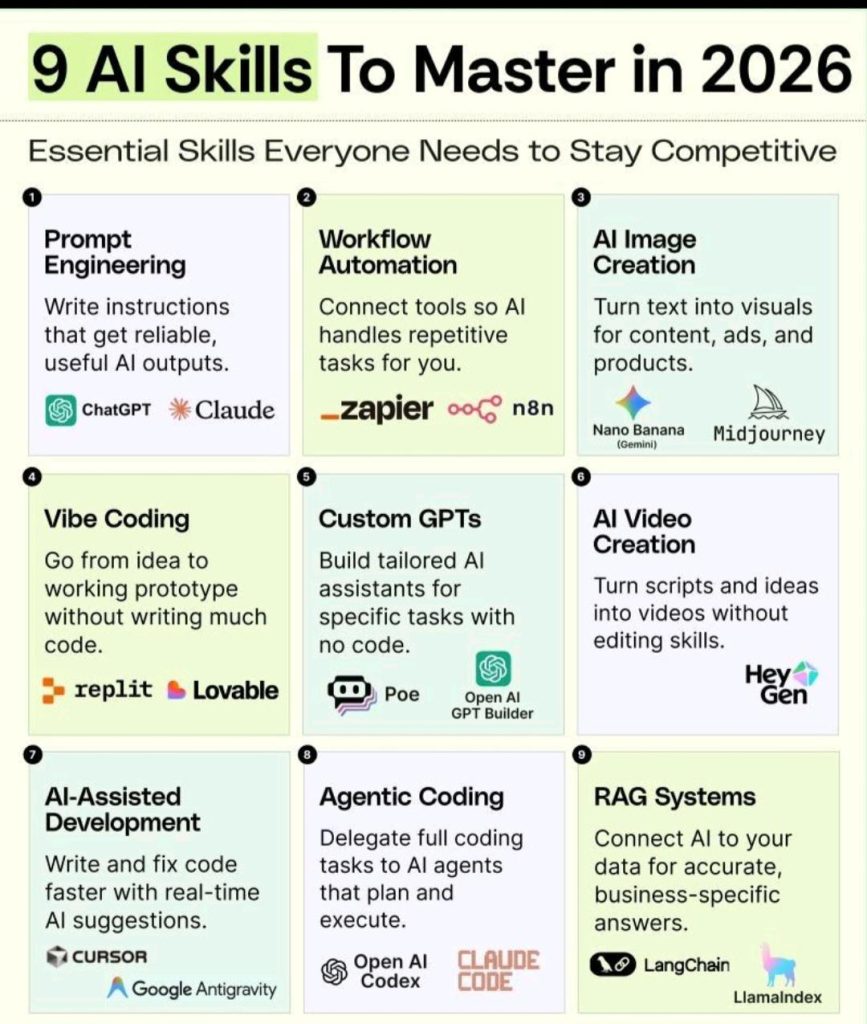
The artificial intelligence landscape has shifted. We have moved past the era of “chatting” with bots for fun and entered a period where AI proficiency is a core professional requirement. As we look toward 2026, the gap between those who use AI as a search engine and those who use it as a strategic partner is widening.
To stay ahead in the modern workforce, you don’t need to be a computer scientist, but you do need to master the tools that allow you to scale your output. Here are the nine essential AI skills you need to master this year.
1. Advanced Prompt Engineering
While early AI use was based on simple questions, modern Prompt Engineering is about precision. It is the art of writing structured instructions that produce reliable, high-quality, and repeatable outputs. Mastering this skill involves understanding “chain-of-thought” prompting and persona setting within tools like ChatGPT, Claude and iSEOAI Chatbot.
2. Workflow Automation
Efficiency in 2026 is defined by how little time you spend on “busy work.” Workflow Automation involves connecting different software tools so that AI handles repetitive tasks for you. By using platforms like Zapier or n8n, you can build systems where an email triggers an AI summary, which then automatically updates a project board or sends a notification to your team.
3. AI Image Creation
Visual communication is faster than ever. AI Image Creation allows you to turn text descriptions into professional-grade visuals for ads, social media, and product concepts. Tools like Midjourney and Gemini’s creative suite (formerly Nano Banana) enable anyone to act as a creative director, bypassing the need for expensive stock photos or lengthy design cycles.
4. Vibe Coding
A new entry in the tech lexicon, Vibe Coding represents the ability to go from a “vibe” (an idea or a concept) to a working software prototype without writing the bulk of the code yourself. Using tools like Replit and Lovable, non-technical founders and creators can build functional apps by describing what they want and refining the “vibe” until the product is ready.
5. Custom GPTs & Assistants
Generic AI is useful; specific AI is transformative. Learning to build Custom GPTs or assistants through platforms like Poe or OpenAI’s GPT Builder allows you to create “specialists” for your business. Whether it’s an AI that knows your company’s brand voice or one that is an expert in your specific industry’s regulations, no-code customization is a superpower.
6. AI Video Creation
Video is the dominant medium of the internet, but it used to require massive hardware and editing skills. AI Video Creation tools like HeyGen allow you to turn scripts and ideas into high-quality video content—complete with avatars and voiceovers—without ever picking up a camera.
7. AI-Assisted Development
For those who do code, the process has changed forever. AI-Assisted Development involves using “copilots” like Cursor or Google Antigravity to write and fix code in real-time. This skill isn’t about letting the AI do the thinking; it’s about using AI to handle the syntax and debugging so you can focus on the software architecture.
8. Agentic Coding
Moving beyond simple code suggestions, Agentic Coding is the practice of delegating full, complex tasks to AI “agents.” Tools like OpenAI Codex and Claude Code can plan a multi-step project, execute the steps, and test the results. Mastering this means learning how to manage an AI “employee” that writes software autonomously.
9. RAG Systems (Retrieval-Augmented Generation)
The biggest limitation of AI is that it doesn’t know your private data—unless you use RAG Systems. By using frameworks like LangChain and LlamaIndex, you can connect AI models to your specific business documents and databases. This ensures the AI provides accurate, context-aware answers based on your data, not just general internet knowledge.
Conclusion: The Future is Collaborative
The common thread through all nine skills is collaboration. The professionals who will lead in 2026 aren’t the ones trying to beat the machine, but the ones who have learned to direct it.
Whether you are a marketer, a developer, or an entrepreneur, these skills represent the new “literacy” of the digital age.
Want to dive deeper into these tools and stay updated on the latest AI trends? Read more at iSEOAI.
 Facebook
 LinkedIn
 X
X
 Reddit